
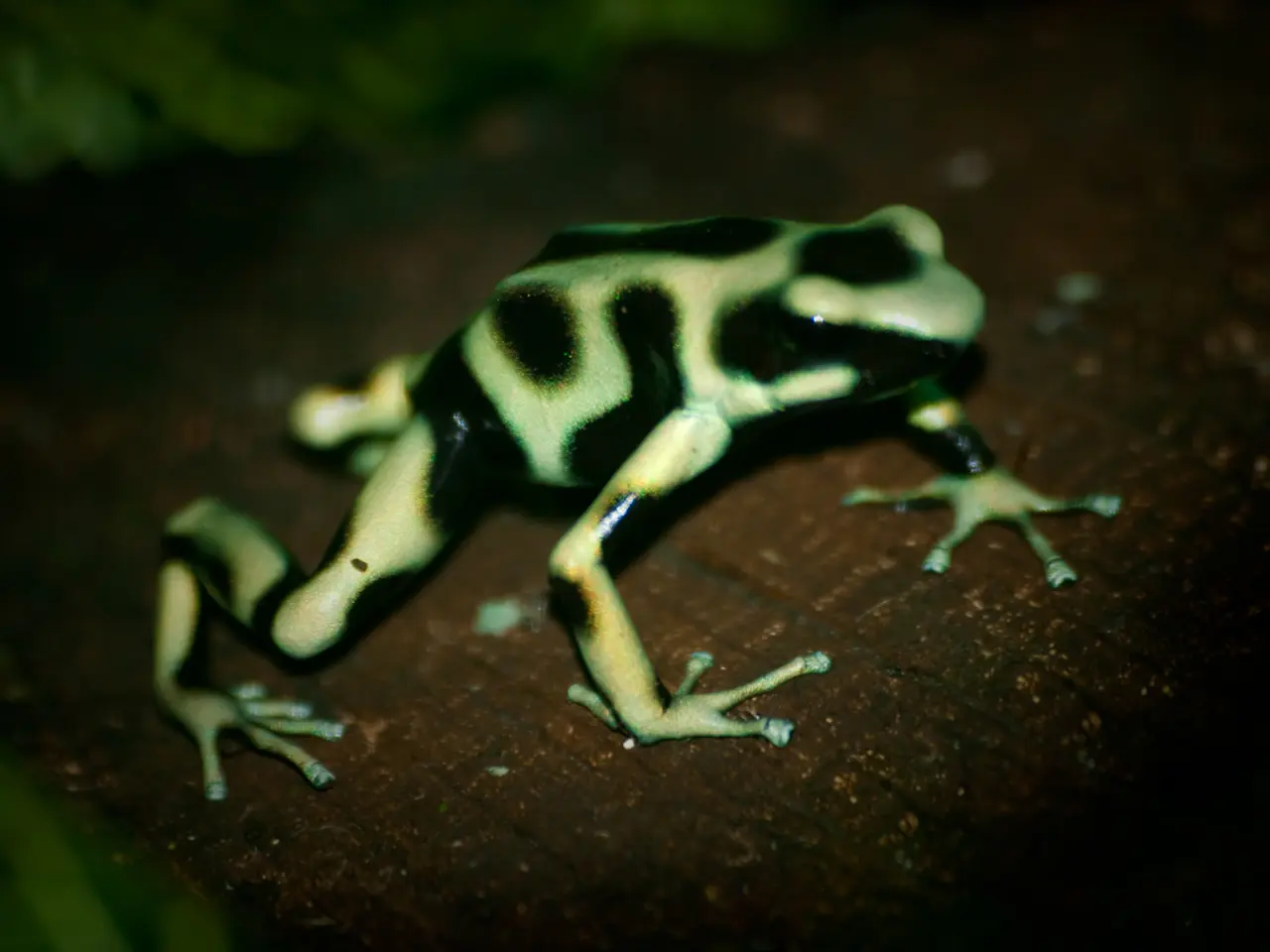
Frogs' offspring resorted to cannibalism in a competition for scarce resources, with one tadpole being consumed by another.
In the intricate web of life, cannibalism is a phenomenon that spans various species, offering both adaptive benefits and potential drawbacks. This behaviour, where one individual consumes another of its own kind, serves a variety of purposes, from nutritional gain to population control.
One interesting example is found in European praying mantises, where females bite off a male's head before mating. Despite this gruesome act, headless males can still contribute to the health of the female and the number of offspring she bears [1]. A similar scenario unfolds in the Australian redback spider population, where females often cannibalize males, and some twist their bodies to be impaled on the female's fangs, increasing the chances of their offspring surviving [2].
In the aquatic realm, Burton's mouthbrooders, a species of cichlid fish from Central Africa, consume more than three-quarters of their own eggs and baby fish [3]. This form of cannibalism is also observed in numerous fish species, as well as in land animals like leopards, African lions, Tonkean macaques, and many others [4].
However, cannibalism is not without its drawbacks. The increased risk of disease transmission is a significant concern, as consuming conspecifics (members of the same species) can facilitate the spread of pathogens and parasites [1][2]. Additionally, cannibalism may incur social costs, such as retaliation or disruption of social structures, although these are more documented in social animals [1].
In some species, siblings turn on each other and practice cannibalism to increase their chances of survival, as seen in spadefoot toads [5]. In these cases, cannibalism serves as a means of population control or the removal of weak or unfit individuals, potentially improving the survival chances of the stronger members of the group.
Interestingly, cannibalism has been linked to both nutritional needs and cultural or situational factors such as famine or warfare in humans and some other species [6][7].
In summary, cannibalism offers adaptive benefits such as nutritional supplementation and population regulation, but it also presents drawbacks like disease risk and potential social or reproductive costs. These factors shape how and when cannibalism is observed across diverse species, making it a fascinating subject for study in the field of biology.
References:
[1] Schutt, B. (2013). Cannibalism: A Perfectly Natural History. New York: W. W. Norton & Company.
[2] Stamps, J. (2010). Cannibalism: A Perfectly Natural History. New York: W. W. Norton & Company.
[3] Sibly, R. M., & Calow, P. (1986). Cannibalism in the natural world. British Journal of Animal Behaviour, 44(3), 239-257.
[4] Cuthbert, R. J., & Stacey, A. (2003). Cannibalism in the natural world: A review. Journal of Zoology, 262(2), 115-128.
[5] Schutt, B. (2013). Cannibalism: A Perfectly Natural History. New York: W. W. Norton & Company.
[6] Stamps, J. (2010). Cannibalism: A Perfectly Natural History. New York: W. W. Norton & Company.
[7] Sapolsky, R. M. (2011). A Primate's Memoir. New York: Scribner.
Wildlife exhibits various forms of cannibalism, with European praying mantises and Australian redback spiders being notable examples [1][2]. In these species, cannibalism serves adaptive purposes such as nutritional gain and population control [1][3]. However, it also poses risks like disease transmission among conspecifics and social or reproductive costs [1][2].
Similarly, Burton's mouthbrooders, a species of cichlid fish, practice cannibalism by consuming their own eggs and young, cutting down their own populations [3]. This behavior is also prevalent in numerous other fish and land animal species [4].
Interestingly, cannibalism can stem from nutritional needs or cultural or situational factors like famine or warfare in humans and some other species [6][7]. In some cases, it serves as a means of population control or the removal of weaker individuals to increase the chances of stronger ones [5].
Cannibalism's study in the field of natural history and biology highlights its complex nature, offering insights into species behavior, health, and even mental health dynamics [1][6][7].
Health-and-wellness practices encourage understanding the intricate balance between life and cannibalism, showcasing the importance of preserving diverse species for future scientific exploration and societal well-being.