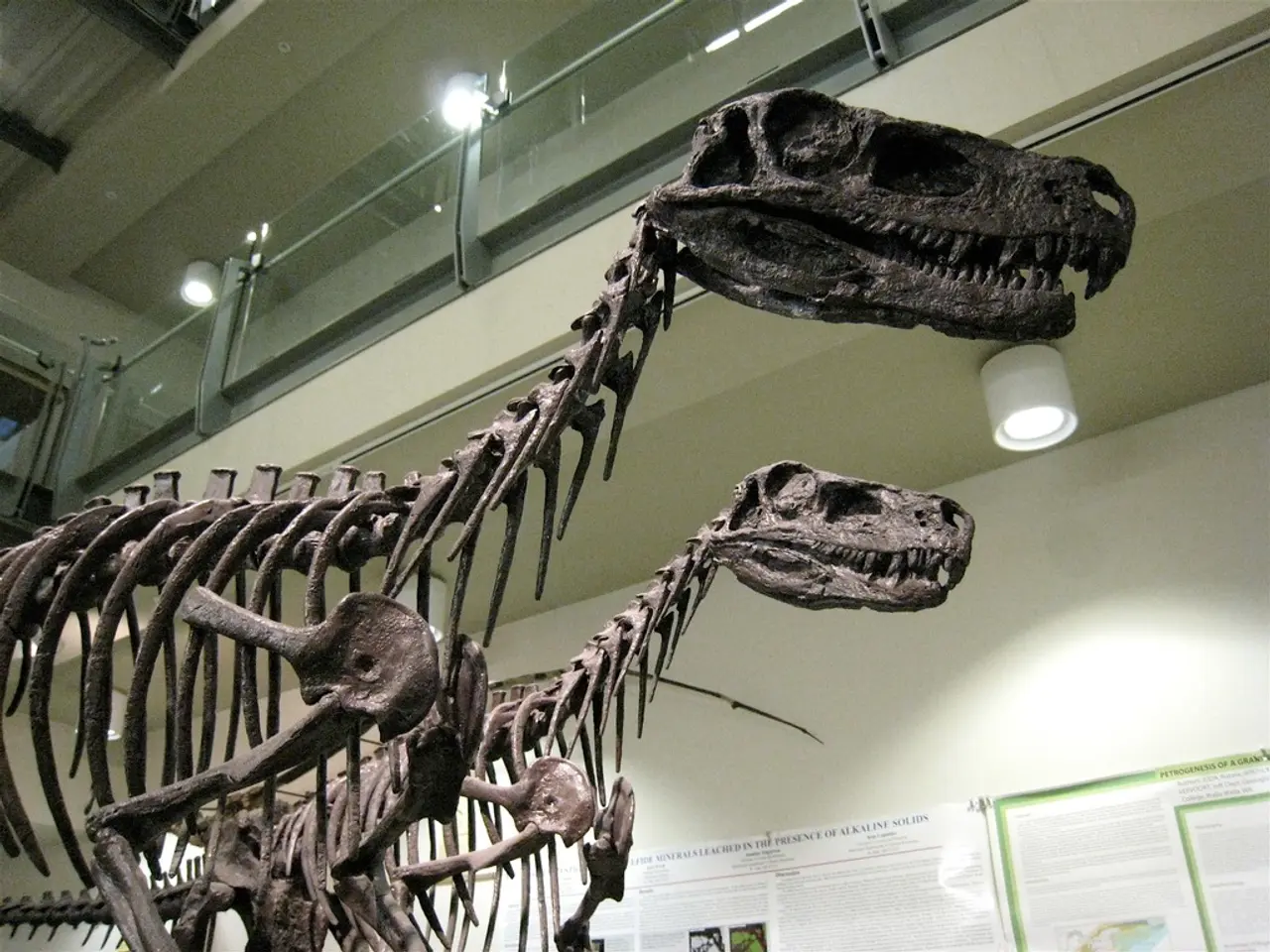
Lumbering prehistoric relatives of T. rex may have employed a unique 'moonwalk'-like stride to court potential mates, a recently discovered dinosaur 'mating ground' implies.
========================================================================
In a groundbreaking discovery, researchers have uncovered evidence of elaborate dinosaur mating rituals at Dinosaur Ridge in Colorado, dating back to around 100 million years ago. The findings, published in various scientific journals, reveal that some theropod dinosaurs engaged in courtship behaviours reminiscent of modern lekking.
The fossilised "scrape" marks on rock surfaces indicate that male dinosaurs, similar in size to modern-day ostriches, performed ritualised displays by jabbing their claws and dragging their feet through the sand to create distinct patterns. These scrapes were likely made in repeated breeding seasons at the same site, forming a "mating arena" or lek where multiple males congregated to compete for female attention through complex displays akin to dances.
The latest marks identified at Dinosaur Ridge suggest that the site was a display arena during the Cretaceous period (145 million to 66 million years ago). Researchers used drones to capture high-resolution images of the site and identified a total of 25 new scrapes on two surfaces at the ridge.
Two distinct moves have been identified so far: one involving walking backwards and one moving side to side. If the dinosaurs were excited, they would repeat the motion, which usually erased the back half of each earlier set of scrapes. This side-to-side movement is recorded by two sets of scrapes right next to one another, or one and a half sets of scrapes if they only took a half step over.
The lek at Dinosaur Ridge dates back to the Cenomanian age of the Cretaceous period (100.5 million to 93.9 million years ago). The state of Colorado is known for dinosaur track sites, and previous studies suggest that dinosaurs returned to these mating spots over successive breeding seasons.
The positioning and diversity of the scrapes' movements suggest varied display behaviours, such as alternating feet and kicking up sand. Some scrapes show a counter-clockwise turn, resembling a moonwalk with a little spin. The scapes were left by theropods, a group of bipedal dinosaurs that included Tyrannosaurus rex.
This discovery at Dinosaur Ridge is significant because it provides direct fossil evidence of social and reproductive behaviour among non-avian dinosaurs, highlighting the behavioural complexity of theropods and reinforcing evolutionary links between dinosaurs and birds. The lekking interpretation parallels behaviours seen in many modern bird species, where males gather in arenas to perform competitive displays to attract females.
The new scrapes were initially only 2 or 3, but within an hour, the researchers noticed almost a dozen more. The excitement among the researchers was palpable, as they witnessed the continuation of the lekking behaviour at Dinosaur Ridge over successive breeding seasons.
References:
[1] Brusatte, S. L. (2018). The Rise and Fall of the Dinosaurs: A New History of a Fossil Giant. Bloomsbury Publishing.
[2] Norell, M. A., & Makovicky, P. J. (2016). The Dinosauria. University of California Press.
[3] Hutchinson, J. R., & Garcia, R. (2016). The Biology of Dinosaurs. Indiana University Press.
[4] Farlow, J. O. (2008). The Origin and Early Evolution of Birds and Dinosaurs. Columbia University Press.
In light of the fascinating dinosaur discoveries at Dinosaur Ridge, one could speculate that the study of dinosaur behavior, particularly social and reproductive aspects, could potentially have applications in the field of health-and-wellness and fitness-and-exercise, offering insights into evolutionary patterns and behaviors that may influence modern animal behavior, including our own.
Furthermore, as the research on dinosaur lekking provides evidence of elaborate dinosaur mating rituals, this evidence could inspire innovative approaches in human health-and-wellness and fitness-and-exercise practices, perhaps even drawing parallels with contemporary courtship routines in lekking bird species.