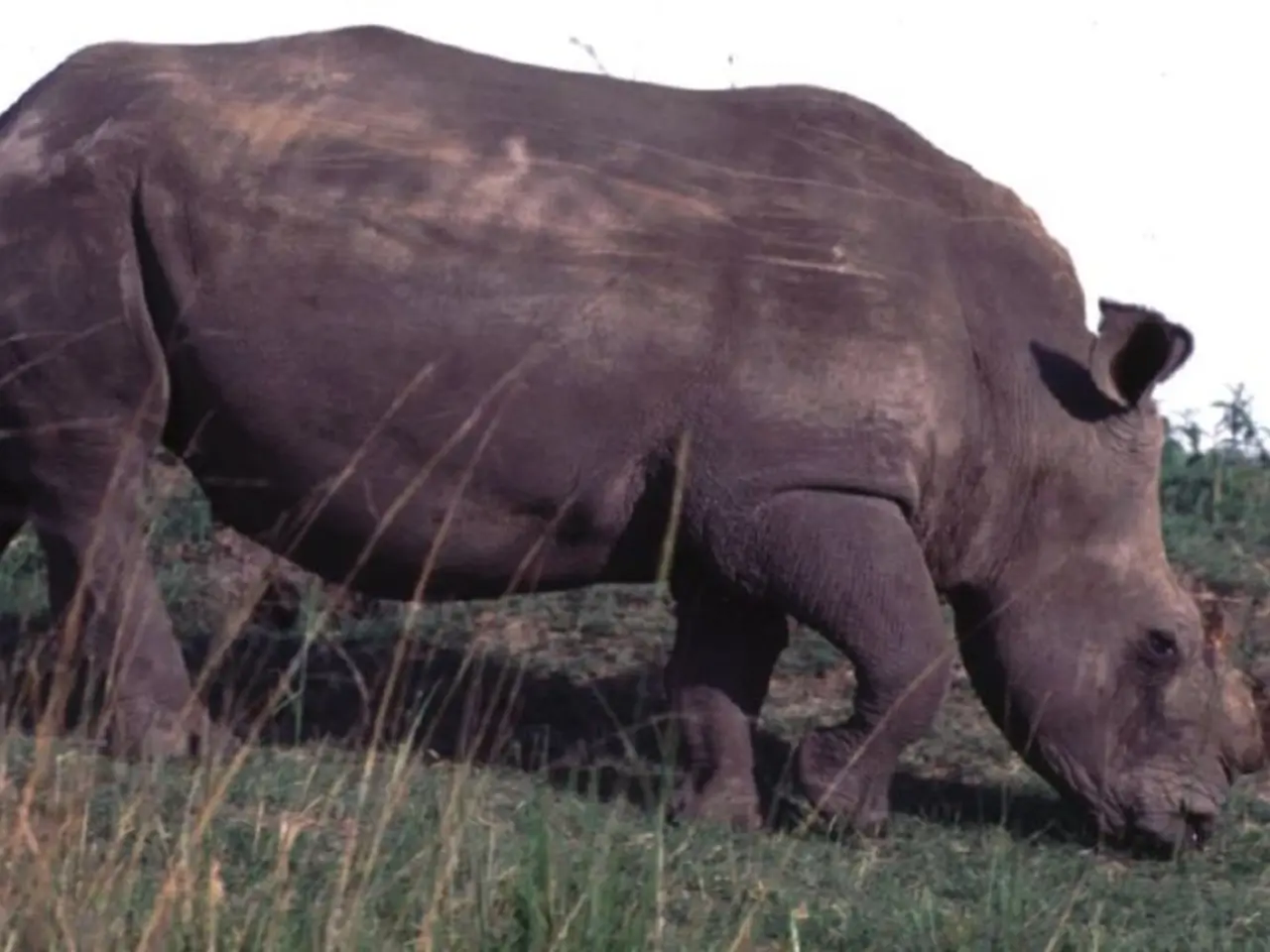
Rhino conservation group, KWS, initiates final attempts to preserve endangered species, the Northern White Rhino, through In Vitro Fertilization
In a significant stride for global conservation efforts, the BioRescue project, an unprecedented international collaboration, is making promising advancements in the quest to save the Northern White Rhino (NWR) from extinction.
The two remaining Kenyan female NWRs, Najin and her daughter Fatu, are currently hosted at the Ol Pejeta Conservancy in Laikipia, Kenya. With the passing of the last two male NWRs, Sudan and Suni, hope now rests entirely on science and these two individuals.
The mission to save the NWR is of paramount importance as Kenya is the custodian of the last two NWRs on the planet. The journey to save the NWR began in earnest in 2019, building on decades of conservation efforts.
The BioRescue program is utilising Assisted Reproduction Technique (ART) to implant embryos into the two remaining NWRs in Laikipia's Ol Pejeta Conservancy. The ART process involves harvesting oocytes (eggs) from Najin and Fatu, airlifting the oocytes to the Avantea laboratory in Cremona, Italy, and using cryopreserved sperm from deceased NWR males to form embryos.
However, while the embryo transfer technique has proven successful with Southern White Rhino (SWR) embryos, and a proof of concept has been affirmed with confirmations of pregnancy, the direct implantation of NWR embryos into SWR surrogates has not yet resulted in live births as of mid-2025. Several viable NWR embryos created via in vitro fertilization (IVF) have been frozen, awaiting further advancement and refinement in embryo transfer methods.
The DG of Kenya Wildlife Services (KWS), Prof Erustus Kanga, stated that they are at the critical stage of getting a pregnancy using northern white rhino embryos. KWS sees the success of the BioRescue project as a historic milestone, reaffirming their commitment to innovative conservation solutions.
The consortium is optimistic that a Northern White Rhino pregnancy could be announced soon, marking an unprecedented victory for global conservation efforts. The BioRescue project, initiated in 2019, is a testament to international collaboration. The KWS will collaborate with international partners in BioRescue to bring back the NWR from the brink of extinction.
In summary, while there's a proof of concept and viable embryos, live births via NWR embryo transfer into SWR surrogates have not yet been achieved. The current conservation status of the Northern White Rhino subspecies remains critical, with only two females remaining. However, with the promising advancements made by the BioRescue project, there is renewed hope for the future of this critically endangered species. The BioRescue project has created pure NWR embryos that are safely cryopreserved, awaiting future transfer.
- The BioRescue project, an international collaboration in environmental science, is attempting to save the Northern White Rhino (NWR) from extinction through health-and-wellness strategies like Assisted Reproduction Technique (ART).
- The project's health-and-wellness initiatives, which involve investigations in medical-conditions, have already resulted in the creation of viable NWR embryos, but direct implantation into Southern White Rhino (SWR) surrogates has not yet produced live births.
- In fitness-and-exercise terms, the BioRescue project is at a critical stage, preparing for an advancement, hoping to announce a Northern White Rhino pregnancy in the near future.
- This historical milestone in the conservation of the NWR species, a significant stride in global politics, underscores Kenya Wildlife Services' (KWS) commitment to health, health-and-wellness, and environmental science, reaffirming their belief in innovative conservation solutions.